Showing posts with label Tummy Time. Show all posts
Showing posts with label Tummy Time. Show all posts
Sunday, December 21, 2014
Postitional Plagiocephaly
Positional plagiocephaly. Flat head syndrome- due to positioning of the infant on the back for extended periods of time. With the back-to-sleep campaign that began in the early 1990s, many parents became afraid of placing a baby on his/her stomach- and left their infants on their back, in swings, and/or carseats. Has the increase in positional plagiocephaly also caused a rise in developmental delays?
According to a 2010 study that was published in Science Daily, babies with flat heads may be at a higher risk for cognitive and motor delays. It makes sense- when an infant is always on his/her back, he/she does not receive the proprioceptive input (feeling of where body is in relation to space) or the neck extension (straightening). The child could potentially be delayed in meeting milestones. After all, it is more difficult to attend to a stimulus while on your back (then on your stomach). Additionally, many babies will take longer to learn how to roll, crawl, sit, and stand, as the core muscles will not be strong enough to move against gravity.
As an occupational therapist, I work with many kids that have positional plagiocephaly. During the session, I teach families how to place their babies during waking hours - as well as how to engage them - to prevent worsening of and correct the flat spot. Although pediatricians recommend back-to-sleep, I encourage families to keep babies OFF of their backs (out of the supine position) as much as possible during waking hours.
What can you do? Here are three "quick" suggestions to PREVENT positional plagiocephaly.
TUMMY TIME! I can't say it enough. Although a Tummy Time article on parents.com mentioned to place an infant on his/her stomach beginning "around the 3-4 month mark," I believe it should happen MUCH earlier. You can put your baby on YOUR stomach- after feeding, while he/she is sleeping, and during waking hours during the newborn stage. It is a great way to bond with your baby and can also help with burping! (In all fairness, the article DID mention this.) ***Just be careful until the umbilical cord has fallen off.
Be a switch-hitter! Switch sides in your arms (after every feed) and in the crib (each night)- get your baby comfortable resting his/her head on BOTH sides.
Just because it is made- does not mean it is right for your child. Meaning- just because Bumbo seats, exersaucers, jumpers, walkers, and swings (etc...) are readily available in many, many stores, they are not necessarily appropriate for your child- in his/her current stage of development. Although those items can be great distractions- extended use may NOT be recommended.
It is very scary to be a parent nowadays- I TOTALLY get it. Remember that you are not alone. If your parent instinct tells your that your child may have positional plagiocephaly, speak to your pediatrician. I am also available to lend my expert opinion about positioning and engaging "activities" to do with your baby.


Tuesday, October 14, 2014
Creating a Crawler. Almost.
Nature vs. Nurture. You can't always change nature, but you sure can nurture- offer tools to help your kiddo meet milestones and achieve success. My 6-month-old is crawling. Almost. Although he has been army crawling for over a week, yesterday he took four purposeful movements in quadruped position (on all fours!).
 My EtiKid(s) began kicking in utero! I actually have videos of my stomach lurching side to side as the older one kicked as hard as he could -from the inside. That being said, I am an Occupational Therapist and Early Childhood Education Teacher. Having studied a lot of child development, I knew enough about the importance of positioning and environment- giving him with opportunities and motivation to meet success. I did not use hand-over-hand cuing to teach him, but he was provided with a stimulating-enough environment and appropriate positions to foster his development. Although every child develops at his/her own pace and nothing with children is guaranteed, offering developmentally appropriate tools can help your child thrive.
Here are 3 QUICK tips to foster those gross motor skills.
1) Play- Someone was almost always on the floor playing with him. He was read to, shown cause and effect toys, and smiled at throughout the day. Also, there is an older sibling. I made sure that there was a lot of interaction between the two and clearly the baby now wants to be just like his big brother. (PS- big brother began crawling at 6.5 mos- and he was provided with the same "tools," minus the older sibling. *sigh
2) Tummy Time- can't be stressed enough. Some "experts" recommend 30 minutes per day to parents. I did FAR more. Pretty much every waking moment was spent on his stomach or upright in my arms (his middle name is "hold me!").
3) Reaching- While laying on a mat, I put some bright toys that were sure to be his favorite just out of reach. This also helped to improve his grasping skills.
Through our efforts to overcome shoulder dystocia, we created a crawling monster. Almost.
My EtiKid(s) began kicking in utero! I actually have videos of my stomach lurching side to side as the older one kicked as hard as he could -from the inside. That being said, I am an Occupational Therapist and Early Childhood Education Teacher. Having studied a lot of child development, I knew enough about the importance of positioning and environment- giving him with opportunities and motivation to meet success. I did not use hand-over-hand cuing to teach him, but he was provided with a stimulating-enough environment and appropriate positions to foster his development. Although every child develops at his/her own pace and nothing with children is guaranteed, offering developmentally appropriate tools can help your child thrive.
Here are 3 QUICK tips to foster those gross motor skills.
1) Play- Someone was almost always on the floor playing with him. He was read to, shown cause and effect toys, and smiled at throughout the day. Also, there is an older sibling. I made sure that there was a lot of interaction between the two and clearly the baby now wants to be just like his big brother. (PS- big brother began crawling at 6.5 mos- and he was provided with the same "tools," minus the older sibling. *sigh
2) Tummy Time- can't be stressed enough. Some "experts" recommend 30 minutes per day to parents. I did FAR more. Pretty much every waking moment was spent on his stomach or upright in my arms (his middle name is "hold me!").
3) Reaching- While laying on a mat, I put some bright toys that were sure to be his favorite just out of reach. This also helped to improve his grasping skills.
Through our efforts to overcome shoulder dystocia, we created a crawling monster. Almost.

Saturday, August 30, 2014
What Should We Play With? For Infants, Ages 4-6 Months
What Should We Play With? Part II
Although it has been a while, I have received requests for the next post to be about the best toys for infants, ages 4-6 months. This is one of the hardest stages because your baby is beginning to be mobile but is not quite ready to be seated upright for extended periods of time in exersaucers and such (refer to this post for more information as to why). Babies at this stage are rapidly developing and becoming more like little people (and much less like little zombies, who primarily want to eat, sleep, be held, and be changed!). Therefore, toys at this stage should be more stimulating, to increase their level of awareness. In addition, toys that work on cause/effect (touch this and lights go on) are important. The following toys can all be found on Amazon.com.
Tummy Time Mat
Tummy time is one of the most, if not THE MOST, important positions for this stage of development. See Part I for more information. The Tiny Love Activity Gym mat is also a favorite, as the lights, sounds, and items to grab while on the back and stomach are stimulating for the babies. In addition, they can practice rolling all over because their are fun things to see at every corner! Sit them up on the mat- have them grab and reach the items that are at shoulder-level... This mat can have many uses!  Activity Table
This Fisher Price table is a great example of the type of toy to give your growing infant. The legs can be modified accordingly to allow the baby to access the various components of the table while in tummy time, on the side, seated, and standing. This activity table has room to grow with your baby - and you will notice that he/she will play differently with the table throughout various stages of development (rolling, sitting, crawling, walking).
Activity Table
This Fisher Price table is a great example of the type of toy to give your growing infant. The legs can be modified accordingly to allow the baby to access the various components of the table while in tummy time, on the side, seated, and standing. This activity table has room to grow with your baby - and you will notice that he/she will play differently with the table throughout various stages of development (rolling, sitting, crawling, walking).  Activity Bars
Your child is working on grabbing, pulling, and pushing. Keep your child busy on walks or long car rides with this activity bar! This is also a great way to have your child practice sitting up...
Activity Bars
Your child is working on grabbing, pulling, and pushing. Keep your child busy on walks or long car rides with this activity bar! This is also a great way to have your child practice sitting up...  Board Books
Touch and feel board books are my favorite for babies this age! Aside from beginning to see words, large pictures and feel textures, they are easy to clean and begin to teach babies how to turn pages (left to right). The books also offer entertainment when seated in tummy time and ensure that you are focusing attention on your baby (after all, who doesn't like attention!?!?!). This book of baby animals was/is a favorite of my EtiKids! They love to hear and make the sounds of the animals!
Board Books
Touch and feel board books are my favorite for babies this age! Aside from beginning to see words, large pictures and feel textures, they are easy to clean and begin to teach babies how to turn pages (left to right). The books also offer entertainment when seated in tummy time and ensure that you are focusing attention on your baby (after all, who doesn't like attention!?!?!). This book of baby animals was/is a favorite of my EtiKids! They love to hear and make the sounds of the animals! 


Wednesday, January 1, 2014
What Should We Play With? Toys for Newborn/Young Infant Girls and Boys
Do you ever wonder what toys to get for your newborn child - or perhaps another newborn/infant within your circle of friends? Although this list would probably have been helpful a month ago, it is never too late to plan for next year (or perhaps an upcoming birthday)!
For the 0-3 Month Crowd:
 Rattles - Anything that can make some noise as the baby kicks and flails while on his/her back. This is how your child will begin to develop an awareness of his/her body. With straps are great for playtime, but do not be afraid to give them ones to hold! Grasping objects in their hands will help develop their sense of proprioception (body in space). This one can be found through Amazon. It is a little bright - but the concept is correct. Keep in mind that your newborn sees the world in black, white and red at first. Don't put the bright colors up to their faces immediately.
 Mobiles - attached wherever the baby plays- just be sure that the baby is not looking behind the head. Place it above the chest but not too low (no grabbing!). Slow moving with simple images to increase focus. A great way to practice tracking of objects! My advice - limit usage in the crib. As we are try to orient baby to day vs. night times, we want to encourage SLEEPING in the crib. We used this one. You can find it on Amazon.
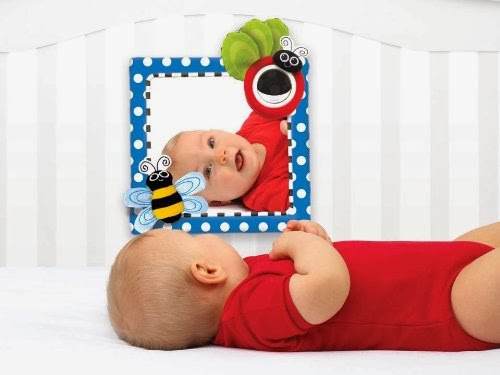
 Mirrors - Really great for helping your child to develop facial recognition. Some of the first smiles you see may be when your child is watching him/herself in the mirror. My own EtiKids loved this mirror, as it was very versatile. We used it for tummy time and while playing with "overhead" toys. We did not use it in the crib because it was very important for him to learn that cribs are for sleeping (also for my own sanity!). We purchased this one from Amazon.
 Tummy Time Mat - As mentioned in previous posts, placing your baby on his/her tummy will increase proprioception, awareness, and social skills, as well as head and neck control. Additionally, it will help prepare your child for other developmental skills, including sitting, crawling, and walking! I used THIS MAT for my EtiKids. I felt that this encouraged a sense of awareness of the entire body, thanks to the addition of the piano. When the babies seemed to need a change of scenery (after playing with the animals), I turned them around to make music with the piano. I also attached the mirror (seen above), so the kiddos could look at themselves in action.
This post begins the series of What Should We Play With? Stay tuned for more developmentally appropriate toys through the ages. As always, it is important to get down on the floor and play with your newborn- it is never too early to begin modeling social skills!
For the 0-3 Month Crowd:



This post begins the series of What Should We Play With? Stay tuned for more developmentally appropriate toys through the ages. As always, it is important to get down on the floor and play with your newborn- it is never too early to begin modeling social skills!
Sunday, October 27, 2013
Raising My Advanced EtiKid

Subscribe to:
Posts (Atom)