
Showing posts with label EtiKids. Show all posts
Showing posts with label EtiKids. Show all posts
Tuesday, October 14, 2014
Creating a Crawler. Almost.
Nature vs. Nurture. You can't always change nature, but you sure can nurture- offer tools to help your kiddo meet milestones and achieve success. My 6-month-old is crawling. Almost. Although he has been army crawling for over a week, yesterday he took four purposeful movements in quadruped position (on all fours!).
 My EtiKid(s) began kicking in utero! I actually have videos of my stomach lurching side to side as the older one kicked as hard as he could -from the inside. That being said, I am an Occupational Therapist and Early Childhood Education Teacher. Having studied a lot of child development, I knew enough about the importance of positioning and environment- giving him with opportunities and motivation to meet success. I did not use hand-over-hand cuing to teach him, but he was provided with a stimulating-enough environment and appropriate positions to foster his development. Although every child develops at his/her own pace and nothing with children is guaranteed, offering developmentally appropriate tools can help your child thrive.
Here are 3 QUICK tips to foster those gross motor skills.
1) Play- Someone was almost always on the floor playing with him. He was read to, shown cause and effect toys, and smiled at throughout the day. Also, there is an older sibling. I made sure that there was a lot of interaction between the two and clearly the baby now wants to be just like his big brother. (PS- big brother began crawling at 6.5 mos- and he was provided with the same "tools," minus the older sibling. *sigh
2) Tummy Time- can't be stressed enough. Some "experts" recommend 30 minutes per day to parents. I did FAR more. Pretty much every waking moment was spent on his stomach or upright in my arms (his middle name is "hold me!").
3) Reaching- While laying on a mat, I put some bright toys that were sure to be his favorite just out of reach. This also helped to improve his grasping skills.
Through our efforts to overcome shoulder dystocia, we created a crawling monster. Almost.
My EtiKid(s) began kicking in utero! I actually have videos of my stomach lurching side to side as the older one kicked as hard as he could -from the inside. That being said, I am an Occupational Therapist and Early Childhood Education Teacher. Having studied a lot of child development, I knew enough about the importance of positioning and environment- giving him with opportunities and motivation to meet success. I did not use hand-over-hand cuing to teach him, but he was provided with a stimulating-enough environment and appropriate positions to foster his development. Although every child develops at his/her own pace and nothing with children is guaranteed, offering developmentally appropriate tools can help your child thrive.
Here are 3 QUICK tips to foster those gross motor skills.
1) Play- Someone was almost always on the floor playing with him. He was read to, shown cause and effect toys, and smiled at throughout the day. Also, there is an older sibling. I made sure that there was a lot of interaction between the two and clearly the baby now wants to be just like his big brother. (PS- big brother began crawling at 6.5 mos- and he was provided with the same "tools," minus the older sibling. *sigh
2) Tummy Time- can't be stressed enough. Some "experts" recommend 30 minutes per day to parents. I did FAR more. Pretty much every waking moment was spent on his stomach or upright in my arms (his middle name is "hold me!").
3) Reaching- While laying on a mat, I put some bright toys that were sure to be his favorite just out of reach. This also helped to improve his grasping skills.
Through our efforts to overcome shoulder dystocia, we created a crawling monster. Almost.


Wednesday, January 1, 2014
What Should We Play With? Toys for Newborn/Young Infant Girls and Boys
Do you ever wonder what toys to get for your newborn child - or perhaps another newborn/infant within your circle of friends? Although this list would probably have been helpful a month ago, it is never too late to plan for next year (or perhaps an upcoming birthday)!
For the 0-3 Month Crowd:
 Rattles - Anything that can make some noise as the baby kicks and flails while on his/her back. This is how your child will begin to develop an awareness of his/her body. With straps are great for playtime, but do not be afraid to give them ones to hold! Grasping objects in their hands will help develop their sense of proprioception (body in space). This one can be found through Amazon. It is a little bright - but the concept is correct. Keep in mind that your newborn sees the world in black, white and red at first. Don't put the bright colors up to their faces immediately.
 Mobiles - attached wherever the baby plays- just be sure that the baby is not looking behind the head. Place it above the chest but not too low (no grabbing!). Slow moving with simple images to increase focus. A great way to practice tracking of objects! My advice - limit usage in the crib. As we are try to orient baby to day vs. night times, we want to encourage SLEEPING in the crib. We used this one. You can find it on Amazon.
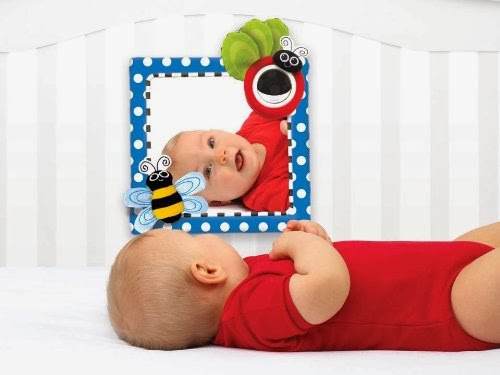
 Mirrors - Really great for helping your child to develop facial recognition. Some of the first smiles you see may be when your child is watching him/herself in the mirror. My own EtiKids loved this mirror, as it was very versatile. We used it for tummy time and while playing with "overhead" toys. We did not use it in the crib because it was very important for him to learn that cribs are for sleeping (also for my own sanity!). We purchased this one from Amazon.
 Tummy Time Mat - As mentioned in previous posts, placing your baby on his/her tummy will increase proprioception, awareness, and social skills, as well as head and neck control. Additionally, it will help prepare your child for other developmental skills, including sitting, crawling, and walking! I used THIS MAT for my EtiKids. I felt that this encouraged a sense of awareness of the entire body, thanks to the addition of the piano. When the babies seemed to need a change of scenery (after playing with the animals), I turned them around to make music with the piano. I also attached the mirror (seen above), so the kiddos could look at themselves in action.
This post begins the series of What Should We Play With? Stay tuned for more developmentally appropriate toys through the ages. As always, it is important to get down on the floor and play with your newborn- it is never too early to begin modeling social skills!
For the 0-3 Month Crowd:



This post begins the series of What Should We Play With? Stay tuned for more developmentally appropriate toys through the ages. As always, it is important to get down on the floor and play with your newborn- it is never too early to begin modeling social skills!
Sunday, October 27, 2013
Raising My Advanced EtiKid

Wednesday, May 23, 2012
Teachable Moments

Monday, June 20, 2011
Liar, Liar, Pants on Fire
Liar -- Liar Pants on Fire…..
It’s a familiar child rhyme originating from a poem by William Blake.
“Deceiver, dissembler -Your trousers are alight
From what pole or gallows -Shall they dangle in the night?...”
While we are not exactly sure what pants on fire has to do with lying, it springs up in play when one child accuses another of lying. Today’s society offers many examples, such as doctors giving vague prognosis, politicians making campaign promises, and family members providing other "reasons" for tardiness at the family dinner. EtiKids is here to shed light on a not-so-positive social skill that continually re-emerges throughout history... The preschooler and the tall-tales. Yes, the start of school often causes many false stories to emerge from our favorite little friends. Although seemingly amusing when a three-year-old does it, it is not so funny when that same person does it twenty years later.
Fact: Preschoolers have great imaginations. However, in their fantasy worlds, it becomes difficult to transition between real-life and make-believe. There is no doubt in their minds that "a monster did it."
For some, the imaginary friend, Jennifer or Jack, is involved in mischievous capers. Wet pants, spilled juice or missed cookies are always Jenny’s fault. A few weeks ago, when a dangling ceiling-fan pull broke, a mini family member swiftly claimed, “I didn’t do it! It just happened!"
Lying is a behavior that all children will try at some period in their lives. If one is lucky, it is attempted at an early age and quickly discouraged. The most important tool a parent can use is to react appropriately and set a positive example for the child. A loving and trusting relationship can begin as early as preschool age.
In the Kaboose.com article, Why Kids Lie (and How You Can Encourage Honesty) by Deborah Bohn, Dr. Michele Borba, a nationally renowned educator and author of Building Moral Intelligence: The Seven Essential Virtues that Teach Kids to Do the Right Thing, describes this behavior as "wishful thinking." She reminds parents that three-year-olds don't think the same way that adults do, and they ACTUALLY WISH that someone else broke your favorite lamp!
Some tips for when your munchkin looks up at you with enormous brown eyes and says, “I saw the little mouse knock over the cookie jar, and it broke.”
1. With a positive response, let the child know the truth is appreciated, offer a warm hug and smile; and then assist in the clean-up of the mess. As it is merely wishful thinking, it is important to address the child calmly. Dr. Borba would even ask the child if he/she wishes that a little mouse would have broken the cookie jar.
2. Avoid asking the obvious question, Did you break this lamp with the soccer ball? This provides a child with the perfect opportunity to lie. While they are standing amidst the shattered ruins of a lamp, ball in hand, one can say, “I see the lamp is broken. We do not play ball inside the house. Please get a dust pan and broom. No more ball playing today.” As a grownup, it is possible to set limits without punitive measures.
3. Finally, set an example as a role model. Children learn by modeled behavior, and they are mindful of all habits good and bad. Lying to a spouse about the price of a new power tool or the purchase of another pair of shoes sets a double standard that children do not understand. If a child consistently tells fibs, it is often helpful to think about what behaviors a child may be observing in and out of the home.
Lying is not a virtue worth keeping and can be stopped. Preschool children are not in positions to discriminate good lies from bad ones; therefore, it is helpful to be consistent. Starting early sets into motion the idea of positive and negative behavior. Most important, it creates a solid foundation for a trusting relationship in the family.
As always, EtiKids is here to help. If your tall-tale-teller (say that 5 times, fast!) is way too inventive, contact us for more information on how to positively reinforce good behavior!
And for conversation purposes: What was the most crafty excuse that your child invented? How was it handled?
Tuesday, June 7, 2011
Divorce vs. Child

Research has been done about divorce and its effect on children’s development for quite some time. Although this article seems to relate to common sense, it was a surprise to find out that children are most susceptible to "side effects" of the separation during and after the divorce. Even more interesting was that math scores and social skills are those most affected by the unfortunate situation. The article, "Children of divorced lack in math, social skills" by Reuters cites time split between parents, psychological impairments (such as depression and anxiety), and parents not spending enough time with their children as reasons for the diminishing of these pertinent skills. It discusses how children are becoming increasingly more anxious and unable to focus on the tasks at hand. In today’s society, which still has an incredibly high rate of divorce among parents, this information can hopefully lead to some changes for the greater good of children. Rather than focus on what is not being done, it is important to recognize behaviors that can be changed immediately:
1) Make a schedule with children present, so they know when they will be spending time with each parent. By involving children in the process, they will feel more in control and comfortable with the situation as they will be able to predict the changes in routine.
2) Help them establish new routines in each house- and stick with them. Although divorce seems like a reason to never speak again, it is important to communicate (amicably) about the child. Attempting to create similar structures and routines in each house will help children feel safe in both locations.
3) Keep a notebook of school assignments. Each parent should be responsible for reading it. Ask the child’s teacher to contribute as well, so everyone can have information about the child. This will help all responsible parties monitor areas that are potentially becoming problematic.
4) Make sure to eat meals with together with the child. Meal time is a great way to model appropriate social skills (eye contact, table manners, reciprocal conversation). By setting the expectation that positive social behaviors should be used always, the child will begin to utilize them in situations in and out of the home. It is important to be consistent and reinforce the social skills as often as possible!
5) Nobody ever wins in divorce, but the children do not have to be the biggest losers of all. Through the use of these techniques, the child can continue to develop without negatively impact the cognitive and social growth. Contact EtiKids for more information.
Monday, June 6, 2011
We're Baa-aaack!!!
Ok, ok, we know it's been a quite a while.
EtiKids blogs haven't been able to make you smile.
We've missed you tons and couldn't stay away.
We're back to give tips on using manners every day.
Social skills are important as kids get older- even more than before.
They will help your child be leaders in the classroom, on the playground, and on a school tour!
The summer has just started, so it is time to prepare.
Help your child succeed and show them you care.
Before next school year starts with a bang-
Let EtiKids help teach social skills to your gang!
So contact us with stories, comments or questions-
We are always hear to listen to and share suggestions.
Looking forward for what's to come, be prepared to hear a lot.
Just remember... It is not too early to teach your tot!
Fondly,
Julie and Co.
EtiKids blogs haven't been able to make you smile.
We've missed you tons and couldn't stay away.
We're back to give tips on using manners every day.
Social skills are important as kids get older- even more than before.
They will help your child be leaders in the classroom, on the playground, and on a school tour!
The summer has just started, so it is time to prepare.
Help your child succeed and show them you care.
Before next school year starts with a bang-
Let EtiKids help teach social skills to your gang!
So contact us with stories, comments or questions-
We are always hear to listen to and share suggestions.
Looking forward for what's to come, be prepared to hear a lot.
Just remember... It is not too early to teach your tot!
Fondly,
Julie and Co.
Saturday, February 19, 2011
Good Sports...

Good Sportsmanship On and Off the Field…
“You cheated.” “Did not!” “Did too!” “Did not!” “Did too!” The biting words are common, endless and universal. Usually viewed during an exchange between children on the playing field, one can easily transfer a similar outburst years later in an adult setting (such as a boardroom). Often the stakes are greater and can lead to dangerous accusations and severe consequences. When is a game so much more than a game?
While there are many forms of cheating, none of them are acceptable. Breaking of rules intentionally or unintentionally for one’s benefit is not a tolerable behavior. The violation can be specific to a game or a more subjective breach of societal norms, customs, values, ethical and moral standards. Permitting the conduct to continue sends a message of acceptance while encouraging the formation of a negative pattern of behavior.
Cheating is not good at 5, 15, or 55 years of age. Sally bamboozles during a game of Candyland without penalty. Johnny secretly deceives while playing cards. Later, both feel that cheating on exams or homework is okay since no one is hurt. Sally is later surprised when she is fired from her job for not providing the proper services for clients, and Johnny is appalled to be fined by the IRS for inconsistencies on his tax return.
Overlooking the negative behavior from a preschooler lets them believe it is all right. EtiKids' curriculum is based on a standard of integrity and quality. Children are expected to be truthful and display sportsmanship. Fostering the social skills that will make them functional members of society comes with practice and expectations. These can be cultivated using a few helpful hints.
1. Learn the rules of the game. Children’s games have rules to follow; adults follow the culture of an institution or customs of a society. Teach children how the game is played. Focus on good behaviors, sharing, listening and playing fair.
2. Learn from mistakes and provide opportunity to do better by practicing. The blame game makes teammates feel bad. Think of how the situation could be avoided and a better way of accomplishing the goal.
3. Learn to lose graciously. There are winners and losers in every game. Losing provides valuable lessons for all. After all, there is always next time...
4. Be polite on and off the field, in and out of work or home. Leave the whining for babies. Showing off is not necessary. Good players are recognized and respected even more for setting a positive example. Trash talk is just that… garbage for the can!
5. Point out the positive. Catch children at their best! Children naturally want to please their parents. Recognize actions that emphasize good moral values and judgment. Simultaneously, it is good to express disapproval of unacceptable conduct; be careful to focus the remark on the behavior, not the child him/herself.
The grownups need to model the behavior for kids. Teaching children to play fairly in the sandbox now will be extremely helpful for them once they grow up. After all, imagine a world filled with love, truth and mutual respect. The dream can become a reality if the kids learn it now.
Saturday, February 5, 2011
Please Sneeze Into Your Sleeve

Winter brings colds, runny noses, sneezes and coughs. Too few layers
outside, lots of clothing for inside, too much heat on in the room and insufficient warmth all raise the chance of becoming chilled and catching a bug! Stress, lack of sleep, holiday overindulgence and viral exposure may increase the odds that a cold will develop. While it may not be possible to live in a sterile environment, there are ways to minimize the damage and not further the virus chain!
An EtiKids favorite, Because a Little Bug Went Ka-Choo! by Rosetta Stone is a reminder of how easily something as small as the sneeze of an insect can have a greater impact. “You may not believe it, but here’s how it happened. One fine summer morning… a little bug sneezed…..”
There is no need to pass along the germs that can cause a cold or worse yet, the flu. The Center for Disease Control highlights the importance of making sure the mouth and nose are covered when sneezing or coughing so infectious droplets stay clear of the mouths or noses of nearby people. To lessen the chances of becoming sick or passing an illness on to someone else, the following suggestions can be added to your list of good health manners to remember:
1. Throw used tissues into the garbage, safely out of reach of an innocent passerby.
Keep soiled tissues off the counter, desk or any other surface readily accessible and easily contaminated.
2. Use an upper sleeve or elbow when tissues are unavailable. EtiKids teaches children to cough or sneeze into their sleeve. A CDC publication states, “Germs are often spread when a person touches something that is contaminated with germs and then touches his or her eyes, nose, or mouth”.
3. Wash hands often. Use soap and water to wash hands vigorously for at least 20
seconds. Sing the alphabet or birthday song to estimate the time. Hand sanitizers are a
handy substitute in the absence of soap and water.
4. Don’t share if you care! Like a secret, personal items like a toothbrush, glass or eating utensils are best kept to oneself.
5. Stay home. The easiest way to transmit a cold is close contact with others such as at work or in school.
Winter time keeps more people indoors in closer contact. Be vigilant and mindful of
others with lower levels of resistance. Social skills includes good health habits too! Be cheerful and stay healthy!
Monday, January 17, 2011
Etiquette with Food Allergies

Food allergies are becoming more common in society, as better medical tests are able to identify the source of a person's discomfort. Although they are more prevalent, the person with the "ailment" needs to become his/her own advocate in order to ensure that surrounding foods can be eaten. It might seem an uncomfortable situation to announce that anything with peanuts cannot be consumed at the dinner table, but it is better to refuse a food than go into anaphylactic shock. As a host or considerate citizen, there are several things that a person can do to prepare for such challenges ahead of time:
1) When inviting guests to a dinner party, ask invitees ahead of time if anyone suffers from food allergies (peanuts, sesame, gluten, dairy, eggs -to name a few). Those with eating difficulties will be thrilled that they will be able to participate in the meal without having to worry.
2) If a person with the allergy offers to bring an allergy-free food to the party, don't hesitate to accept the offer. That way, the person knows what is in the food and won't get sick, and others will have the opportunity to sample a new dish!
3) It is alright to ask about the allergy. For example, a person with Celiac Disease is oftentimes extremely happy to share details about the allergy/disease, as it raises awareness of the problem. Every question is a good question!
4) Consult with cookbooks or online recipes for easy meals that are allergy-free. It is a win/win situation, as new foods get to be sampled and everyone can eat!
5) Ask before eating suspect foods in front of others- especially children. So many children have severe peanut/nut allergies and can suffer from a serious allergy attack if they touch something contaminated then stick their fingers in their mouth.
Eating in front of children can be a difficult situation, as they often do not fully understand their "ailment." When participating in an event with kids, consider all allergies that a child might have and potential alternative snacks. At EtiKids, we recognize that this is a challenge, so we often try to provide two choices: fruit and vegetables. Dips are often provided as well, so the kids can experiment with healthy snacks in a way that can work for everyone. Best of all, no one is left out of the fun!
Wednesday, January 12, 2011
Cell Phones and Manners

They are everywhere… No longer just a means of communication, they have often become appendages that cover ears. Found all over the world, they vary in size, width, color and shape. Some have bling, others sing and almost everyone will ring! Yes, the cell phone is here to stay.
Holiday cell phone gifts must have been on the rise. People were checking and texting at the movies. A wedding was the location for individuals glancing at sports scores and online searches to bide time until the conclusion of the ceremony. The dinner table took on a special ambiance as phones rang and conversations ensued. Laps were the area of visual focus for twitters, tweeters and Facebook addicts in the family room. There was the woman yelling into the phone at her sister in the department store. The car became a prime place for filler-time conversations. With such widespread use and availability, are what constitutes proper cell phone etiquette?
1. When asked, please listen. Movie theatres, playhouses, museums, doctors’ offices and other public places often make special requests for patrons to turn phones to off. Ringing phones break concentration, change the tone and interfere with the need for quiet.
2. Be respectful of others sharing the space. One cannot always enjoy the privacy necessary for a conversation. When space is at a premium or there are too many people, (ie. the elevator) turn off the phone. Or at least put your conversation on hold for those few moments.
3. Adjust all volumes, phone rings and speaking voice. It’s frightening to have a phone break the silence with a ring loud enough to wake those in Australia! The other no-no is speaking in a voice loud enough for others to hear. Keep your conversation brief and speak in a low voice when absolutely necessary.
4. Turn the phone off with loved ones, friends and during meetings. Everyone is important. No one is cooler or busier because they are talking on a cell phone while socializing with other people. Try not to interrupt an engaging conversation by taking a call mid-sentence, during dinner, on a date or even job interview. The call can go right to voice mail and returned at a more convenient and private time.
5. Driving and texting don’t mix. Multi-task at home or at work, not when it can impact the lives of others. Many laws have been created regarding the use and limitation of cell phones. Check your state regulations. If there is urgency for a call, pull over to the side of the road. After all, the life you save could be mine!
Cell phones are a remarkable invention; however, there can be a point when they are overused, abused, an annoyance, a bother, an irritation and a nuisance. EtiKids classes offer children the opportunity to learn the etiquette of cell phone use. Kids learn how to answer, leave messages and explore the manners and responsibilities that are necessary to use and own a cell phone. It’s a social skill for all ages... Set an example for others, starting now. Courtesy is contagious!
Wednesday, December 29, 2010
New Year's Resolutions

(Forgive us friends, for we have been negligent. It has been almost 2 months since our last post... Better late than never!)
As the New Year approaches, it is a good time to review some of last year’s social highlights and check for areas to change, improve or tweak. When this year’s holiday parties come to a close for 2010, there is opportunity to evaluate and take note of the value of one’s social skills.
All month long there have been episodes of individuals’ double-dunking, licking fingers at the table and the best, eating crudités directly over the platter as excess sauce was drooled right into the dip bowl (Yuck)! There were observable first dates with conversation flowing in only one direction, missed appointments and inappropriate attire at parties and social gatherings. During a shopping frenzy at a local shop, acceptable behaviors were replaced with nasti-tudes, observed when two women got into a vulgar verbal quarrel.
Friendships were strained by inappropriate comments, breakdown in communication and lack of sensitivity. Families were lax in extending common courtesies to one another. Bullies ruled in schools as administrators were in a quandary of how to handle situations. Words such as please and thank you often were forgotten in conversations and feelings were hurt. Sorry was often too late.
Farting and other bodily noises increased, becoming much more visible and acceptable on TV, in the movies and in comedy shows. Radios blasted in decibels so high, they registered on the Richter scale. Guests and hosts forgot their manners by having unrealistic expectations and making impossible demands of time and resources.
As cell phone technology improved and use was on the rise, basic etiquette spiraled downward exponentially. It was not unusual to dine with people texting at the table, conversing in loud tones in quiet or public places, and checking scores at social functions.
Conducting business in the waiting room of a doctor’s office was one of the many examples of lack of consideration.
As we move into the New Year, EtiKids invites everyone to think about adding a resolution that gives latitude to gratitude by incorporating a new social skill. Here are a few ideas!
Have a conversation without using the word “I”. Give others the leeway to share their thoughts, ideas and experiences. Listen more.
Add the magic words please and thank you in conversation, especially when talking to children. According to research, it takes 21 days to form a new habit. Use the next month to assure the addition of those words to daily vocabulary. Set the example, model the behavior and watch the words appear in the child’s every day language
Make a commitment to learn table manners. Give yourself the freedom to enjoy social situations where etiquette will come in handy be it a first date, business dinner, formal fundraiser or casual celebration.
Take time for pampering oneself. Getting enough rest and relaxation fosters patience and politeness with others.
Book an EtiKids party or class for your next home or school function. Any EtiKids workshop is a welcome and fun addition to an organization’s meeting, professional seminar or business event. Programs are fun, entertaining and filled with strategies to include etiquette in a corporate culture and everyday life.
Please let us know how you are doing. We invite you to share a success story or tell us how your resolutions are progressing. May the year bring joy, good health and peace to all….Thank you!
Monday, October 18, 2010
Don't Yuck My Yum

Yuck! Everyone has heard the word, spoken the word or wanted to say it at least one time. It could happen eating a family dinner, tasting a new restaurant dish, sampling an unlucky-pot dish or simply nibbling at a bad meal in the home of a friend. Adults think “Yuck, this taste’s awful,” and a child might exclaim, “This is yucky!” The burning question: does one actually have to eat the food, or is there a socially acceptable way to deal with the “yuck?”
The bad food situation can arise either at home with family or in public. Often, one look at a dish with a unique presentation (fish with the head attached) or hearing the inclusion of an unusual ingredient (sardines) is enough to cause the exclamation “Yuck!” Begin exposing children to different kinds of foods at an early age, as that is the time they are most impressionable. Studies have shown that children need to be exposed to new foods 10 times before actually being able to decide whether or not they like it. Therefore, introduce it in fun and different ways. Just in time for the Halloween season are Chocolate Avocado Cupcakes with Avocado Buttercream Frosting, which can be found on the blog Chocolate and Tea (avocados are seriously mystical foods!).
Another way to lessen the stress of unwanted/"yucky" foods at mealtimes: engage children by planning meals together. Use a food chart, shopping for ingredients and teaching them how to make healthy food decisions, which will ultimately prepare children to make better choices for themselves.
Finally, parents can explain that the word “yuck” is not an acceptable way to describe food on the table and provide a suitable alternative response. If the child does not wish to try something, a simple No Thank You will suffice. After all, not wanting to sample a dish does not mean that manners should be lead astray!
It is important for children to realize a meal takes time and effort to concoct. Our EtiKids can understand preparation communicates caring for others and makes people happy. Expressing feelings by making faces or describing how yucky the food tastes is hurtful behavior and should not be excused. It is also important to be sensitive to other people's feelings; everyone does not have the same interests in food, and various choices should be respected. In EtiKids, one of our favorite phrases is "Don't Yuck My Yum!"
At the home of a friend or in a restaurant with other people, there is ample opportunity for exposure to strange or unusual foods. First, one should never say “yuck” out loud. Second, “Thank you, I’ll try a little,” is the perfect way to accept a small helping if it is a new food or one is unsure of the taste. If the flavor is too strong or tastes unpleasant, one can hide the fact by playing and pushing small pieces around the plate. Please do not feed the pet as many animals have allergies and can become very ill. Spitting into a napkin is never good manners!
Individuals with food allergies, medically restricted diets can say, “It looks delicious, but I am gluten free.” For ingredients which are unknown or suspect, “No thank you, I have a food allergy,” is a polite and acceptable answer.
As grownups, set an example and be a role model; try new foods and experiment! Try to sample different dishes and be open to new tastes and textures... But please, Don't Yuck My Yum!
Monday, September 27, 2010
Potty Talk

Oh Sh#%! Da*& it! F#@*7! Hearing these words pop out of the mouth of a preschooler (or anyone else) can make hair stand straight out of one’s head. Needless to say, it usually happens at an inopportune moment such as a social gathering, in class, or at the dinner table! The 2-year-old shouting “Stupid head” or “Butthead” at passing cars usually triggers an instant alarm of fear as the parent realizes this could result in a carpool expulsion. Children are fascinated with “bad” words, and learn them quicker than their assigned vocabulary words. The initial response of laughter that the child receives is usually more than enough to fuel continuous repetitions of the offending language. The worst part is this negative behavior will take exponentially longer to break!
The issue raised is not just limited to curse words. Bathroom or potty language and words which EtiKids refers to as S-words (stupid, sh*t, sucks, and shut up) can also be a problem faced by a parent or teacher. Older children may think it is “cool” to use words that describe bodily functions and noises, while younger children mimic what they hear. Sometimes repeating bathroom words is a way to get a reaction or gain attention. Realize it is a way of experimenting with language. So, if trying out new words and learning how to communicate are part of learning social skills and manners, what is the best way to re-train a potty mouth child?
Displaying a lack of interest is the simplest tactic to phase out incessant repetition of naughty expressions. Without strong feedback, most preschoolers won’t bother repeating these terms. Why bother if you can’t get a rise out of parents?
Ask the child what the word means. Discourage use of words whose meanings are unknown. Explain why some words are offensive and hurtful to other people. X-rated vocabulary and forbidden words are not “cool” and can be banned by parents because they are inappropriate in almost all situations.
Restrict bathroom words to the restroom. After a while, the child typically finds it tiresome to run back and forth to the lavatory just to talk about bodily functions and spill out potty words.
Control word categories that are on the fringe. Growing up, the use of "S-words" was not tolerated. These expressions included: stupid, sh*t, sucks and shut up. Although the latter has become an acceptable phrase of surprise (or synonym for no kidding), telling someone to “shut up” is perceived as rude and insensitive.
Monitoring TV programs can limit some exposure to words with derogatory meanings such as “butthead”, which became popular terminology following MTV's programming. Remind children that using insulting words or expressions can become a habit, slipping out without any warning and be embarrassing for everyone.
Although the word hate has different meanings, we mention it here. It can be used in a spiteful manner and is a learned behavior. Shouting “I hate you!” to a parent is universal to children all over the world. A little 4-year-old friend repeated her mother’s favorite quote, “Hate is a very strong word, and we should never use it!” The More You Know public service campaign, (NBC 2003) reminded us, "Hate is a four-letter word. So is love. Which word will you teach your child?"
Finally, the very best way to diminish the use of negative words is to set a positive example for children. Replace curse words with alternative phrases such as “Darn it! Dang! Good Grief! Geepers Creepers! Rats! Shucks!”
Let us know your favorite expression! Or most inappropriate story. :) Contact us at Dear Julie or info@etikids.com with your stories.
Thursday, September 23, 2010
Hole's Not Big Enough?

People come in a variety of colors, sizes and shapes and often face difficulties during their lifetime. Some of these challenges may be emotional while others are more physical and visually apparent. It always seems children are most astute in noting all our differences. Some comments are positive observations: a teacher’s new hairdo or mom’s new dress. More often than not, these comments are made verbally at higher than normal decibels, in extremely trafficked areas, and simply embarrassing. “Why is that man so much smaller than me?” “Look at the lady with no hair!” Certainly there are a multitude of examples to share that just “pop out” of a child’s mouth. How do you address the child’s remark without squelching curiosity, teach an important social skill and maintain a semblance of sanity?
First, if the comment was audible, offer apologies immediately. “I would like to apologize for the comment that was made,” is one way to express your regret. This clearly serves as an example of sensitivity, provides an atmosphere of understanding and models a social skill. Softly assure the child everything will be explained in a more appropriate place. Then address the issue immediately. Using a concrete example helps children conceptualize information with greater ease. Find a quiet place where the child can sit and ask a few questions. More often than not, a simple explanation is all that is required. Don’t worry the beet red color disappears quickly!
Second, open the discussion by asking about feelings. “What would it feel if a person said something unkind or hurt your feelings?” Offer the child an opportunity to whisper something softly if they need to ask a question. This way feelings won’t be hurt. Sheryl Eberly, author of 365 Manners Kids Should Know, explains that “people with disabilities don’t want to create a scene wherever they go and shouldn’t have to explain their situation to strangers.” Throughout the EtiKids program, focus is placed on similarities people share and identifying the way differences enhance our environment and our world.
Many school programs now offer sensitivity training by using wheelchairs, earplugs to simulate situations facing people with disabilities. Ask the child to use one hand or keep eyes closed while picking up their toys to experience a little of the physical challenges that exist.
Third, examine personal perspectives. Many times we are unaware of nonverbal information transmitted to others. Any actions (eye rolling, head shaking, frown or scowl) or comments which highlight negative perceptions are easily and rapidly adapted by children. Dr. Haim Ginott compares children to wet cement. “Whatever falls on them makes an impression.” Why are bad habits learned so much quicker than good ones? Opening the door for someone in a wheelchair, helping someone who can’t reach an item on a top shelf in the grocery store, or complimenting someone’s new outfit can help a child see what positive social norms dictate.
Children aren’t the only ones making mistakes. Adults sometimes share inappropriate comments and may benefit from a manners makeover too. “You are really that old?” “Why did you get fired from your job?” “Sally is so fat!” Taking the time to consider how a comment will impact someone else can prevent hurt feelings and serve as a model to children. When we err, the quickest, most effective and easiest way to remedy a situation is just to say, “I’m sorry”.
Share your harrowing story with us at Dear Julie or info@etikids.com. Remember Mark Twain’s quote, “Better to remain silent and be thought a fool than to speak out and remove all doubt.”
Tuesday, September 14, 2010
Sleepover and Out!

Remember how scary it was to sleep at a friend’s house for the first time? There was fear of not knowing where the bathroom was, waking up in the middle of the night and wanting to go home. What if food tasted funny or you got a bellyache in the middle of the night? Even more worries surfaced when the bathrobe, dangling on the door, appeared to be a ghost. Sometime during the day, while playing with lots of different toys, the idea of turning the playdate to a sleepover seemed like a good idea. Now what?
Pack those pajamas! Create a simple list so children can participate in the packing process. This allows the child to become an active, willing and responsible participant. It also helps kids know what they will have to unpack when returning home. A teddy bear or favorite book can help ease the transition. Packing personal care items will be appreciated by the host, who won’t have to supply toothpaste, toothbrush, or other toiletries.
Dress in the best manners: Leave bodily noises like farting or burping for the bathroom. Play fair and include the host’s runny-nose brother or squealing sister in games. Secrets are for sissies and make others feel bad. Remember to ask before using the phone or taking something out of the refrigerator. Absolutely and positively respect privacy. Resist the urge to peek or snoop into the belongings of other people.
Neatness counts. Ask the host where to place the overnight bag. Encourage children to keep all their clothes and toys in or on the suitcase. Leaving shoes and stinky underwear all over the house will not earn a return invitation. A sleepover is not a scavenger hunt for dirty clothes or an excuse to mess up someone else’s room!
"With a butterfly kiss and a ladybug hug, sleep tight little one like a bug in a rug." (Author: Unknown) Bedtime usually comes right in the middle of a favorite TV show or winning game. Parents know that chattering and giggling are part of every sleepover, but they won’t want to be on patrol all night long. When the host parent says “Bedtime for teddy bears and all other little children,” the guest should start to get ready for bed, even if the host child runs around the house like a wild animal!
Not all families are the same. As a guest, one should keep an eye on the customs of the house. Politely follow the bedtime ritual of the house, which may include bedtime snack, teeth brushing, and bedtime story.
EtiKids stresses the use of please, thank you, excuse me and sorry in all social situations. Reinforcing these words at home helps them become an integral part of the child’s vocabulary. “Thank you for inviting me to sleep at your house” can be followed up with a written note to encourage politeness, writing and social skills. Remember, even though a child may not always express their gratitude at home, they are capable of thanking their host, learning to be a gracious guest and helping with simple and caring tasks.
With all of the helpful information above, your child is ready to put it into practice. As stated in Maurice Sendak’s book, Where the Wild Things Are, "Let the wild rumpus begin!"
Tuesday, September 7, 2010
Gossip

What is it about gossips that make them so bad? After all, it is only words that are used in gossiping (sharing a rumor or personal story belonging to someone else). Once words are spoken, they cannot be recycled, erased, collected, expunged, obliterated or changed. Passing along information spoken in confidence or that may have heard from someone else can hurt another person very badly. Sometimes it can backfire and put the person who spread the story in trouble too!
Being sensitive to the feelings of others can be a useful guide. Putting oneself in the shoes of another can help understand how it may feel! Sharing information that is personal, health or job related should be left to the individual if and when they are ready to share the information.
Some quick tips...
If the information seems too personal, keep it to yourself.
If the information is hurtful, don’t pass it along.
If the information serves a malicious purpose, break the chain.
If the information can affect someone’s livelihood, don’t repeat it.
Leticia Baldridge, author of the Complete Guide to Executive Manners cautions, “Think before you participate in gossip, either by adding to it or by reinforcing it, even if you believe it to be true.” Time is spent building self esteem and making good decisions; choose what appropriate dialogue. Emphasis is placed on doing the right thing such as refusing to listen to the idle chatter, redirecting conversation to other topics, walking away or taking a leadership role by defending the target of the gossip by saying, “I don’t think Jane or Bob would want this to be discussed”.
Parents can set an example for their children by diffusing gossip-y conversations. Change the topic to something less volatile. Explain that the information may be incorrect and should not be further transmitted. Discuss feelings regarding communication of personal information. Clarify how easily rumors begin and the damaging effects they can have on a person (consider role-playing). If this seems confusing, perhaps a class that enables children to focus on the positive development of their social skills, such as learning to converse, rather than the spread of vicious gossip is in order. Contact EtiKids for more information!
Think of your mother's words: if you don't have anything nice to say, don't say anything!
Sunday, August 29, 2010
The Plane Truth About Flying

The internet is flooded with travel specials and more people are taking to the air. Airlines are filling planes to capacity leaving little leg room, decreasing services and increasing charges. While the weekend or holiday get-way can be a challenge, taking a child or two can test the mettle of the calmest individual. There are helpful hints and plane etiquette tips to make travel less stressful, a positive experience for children and an enjoyable pastime for all passengers.
Magic words, including Please!, apply in all situations. EtiKids emphasizes use of the words please, thank you and excuse me in all situations. Remembering to say please to attendants when requesting service or thank you to the pilots for a safe flight are common courtesies appreciated by staff. However, we caution the overuse of excuse me as a child repeatedly kicks the passenger seat in front of them or the window passenger marches frequently in and out of the row!
Define your space and stay within the limits. No one wants appendages flailing, sweaty body parts touching, and aisle passengers leaning to peer out the window, invading personal space. Bring reading materials or work that fit on a tray table. Use an arm rest to help define boundaries. Climbing over a sleeping passenger is a no-no! Gently wake them and excuse yourself before passing knee to knee.
Be kind to your fellow passengers. Personal hygiene prior to flying is paramount; perfume or cologne in closed quarters is not the answer to body odor. Christopher Elliot, travel columnist reinforces this in his column, 5 Ways travelers Have Lost Their Manners. The msnbc.com contributor writes, “One of the most common complaints I get about inconsiderate travelers is the way they smell”. Do your nails at home, not in the cabin of the plane. Keep idle chatter to a minimum especially when your neighbor is not interested in conversing. Turn down the volume of headphones- opera may not be for everyone!
Maintain parenting skills at all times. To keep children happy, keep them occupied. Offer food, games and treats special for the airplane. Keep the noise level of electronic games on mute or lower sound to minimum even when using earphones. Running in the aisles is dangerous, disruptive and not an appropriate activity for the plane. EtiKids' focus on social skills includes making time to practice age appropriate social skills and discuss expectations prior to taking flight.
Children can learn the joy of travel at an early age. Offer guidance and allow them to make choices about what they will bring. Let them benefit from the responsibility of carrying a small backpack or suitcase with wheels. Vacations can be relaxing and fun with a little planning.
I hope the Plane Truth was helpful. Happy Flying!
Tuesday, August 24, 2010
Be A Host With The Most

Do you love the idea of entertaining but stress once people accept your proposed engagement? Most people don't realize that a considerable amount of planning is required to become the "host with the most." Visiting someone’s home can be a satisfying experience for both guest and host; responsibilities for the host begin by extending a sincere invitation. Choose a group that will have fun together and share a common interest. As RSVP’s are received, ask about any dietary restrictions or allergies (this includes pet allergies too!)
Organize. Organize. Organize. Use lists for the menu, cleaning and delegate assignments. For those individuals offering to bring something, politely provide guidance or assign a complimentary side dish. Prepare as much as possible ahead of time to decrease stress and increase enjoyment.
Greet everyone warmly and help them feel welcome by making introductions and smiling. Offer interests as topics of discussion.
Provide appetizers and/or drinks as soon as guests arrive. Who wants to drive for 45 minutes and not even get a glass of water?
Be a schmoozer and socialize with everyone. Pull those who may be isolated or uncomfortable into the folds of conversation.
Make sure guests leave safely. Walk everyone to the door as visitors exit. Thank them for coming.
The success of a gathering lies in the company of those invited. Although parties often include food, the laughter, pleasant conversation, and sharing of good times are what make the experience gratifying for everyone.
Creating that comfortable environment is the job of the host. Children can learn those skills by observation and practice. Give them a task to perform. Each child can be given age-appropriate activities and are more than capable of assisting in the kitchen. Tasks include: setting the table with some guidance, greeting guests and helping them find their seating. Create opportunities to participate in conversation – rather than monopolize -and practice using their good manners prior to having any visitors. These social skills and more are learned in EtiKids classes.
As Emily Post said, “Manners are a sensitive awareness of the feelings of others. If you have that awareness, you have good manners, no matter what fork you use!”
Monday, July 12, 2010
Rules for Eating Utensil Placement

In the Dear Julie section of www.etikids.com, a question was recently submitted about the placement of eating utensils. “Where are the utensils placed during and after a meal?”
As I had responded to the “anonymous” writer, the rules of dining etiquette are simple and finite. They clearly signify a brief pause in eating or the end of a delicious meal. Using proper dining etiquette ensures that the place setting, tablecloth and person’s lap stay clean throughout the meal. Therefore, used utensils should never be placed on the table.
Soup bowls are often brought on flat plates, which is where the spoons should be placed when the portion is complete. According to askmen.com, the same is true for position of spoons for tea and shrimp cocktail forks.
When taking a break between bites, the fork should be placed on the left side of the plate and the knife on the right. This is because when one uses the knife and fork, the knife is held with the right hand (to slice), while the left hand holds the fork (to keep the the food in place).
If you would like a second helping, put the fork and the knife together on the right with the handles facing towards you. This will make room on the plate for another portion of food.
When finishing a delicious meal, Chef Albrich will tell you that the knife and fork should be placed parallel to each other with the handles pointing to the right. Jennifer Maughan will remind you to place them more towards the center, so they don’t fall off the plate when removed by a server.
Teaching children the three tricks to utensil placement will ensure that the social skills become an innate behavior. Children will not have to think about how to behave properly: they just will. They can teach their friends, the word will spread, and you will no longer have to worry about flying utensils when servers clear your place setting.
If you have an etiquette question, it can be answered for you! Go to the Dear Julie section of the www.etikids.com website. All questions are anonymous; all tips are free!
Subscribe to:
Posts (Atom)