Do you ever wonder what toys to get for your newborn child - or perhaps another newborn/infant within your circle of friends? Although this list would probably have been helpful a month ago, it is never too late to plan for next year (or perhaps an upcoming birthday)!
For the 0-3 Month Crowd:
Rattles - Anything that can make some noise as the baby kicks and flails while on his/her back. This is how your child will begin to develop an awareness of his/her body. With straps are great for playtime, but do not be afraid to give them ones to hold! Grasping objects in their hands will help develop their sense of proprioception (body in space). This one can be found through Amazon. It is a little bright - but the concept is correct. Keep in mind that your newborn sees the world in black, white and red at first. Don't put the bright colors up to their faces immediately.
Mobiles - attached wherever the baby plays- just be sure that the baby is not looking behind the head. Place it above the chest but not too low (no grabbing!). Slow moving with simple images to increase focus. A great way to practice tracking of objects! My advice - limit usage in the crib. As we are try to orient baby to day vs. night times, we want to encourage SLEEPING in the crib. We used this one. You can find it on Amazon.
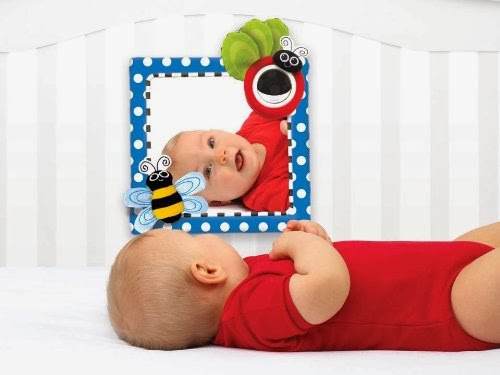
Mirrors - Really great for helping your child to develop facial recognition. Some of the first smiles you see may be when your child is watching him/herself in the mirror. My own EtiKids loved this mirror, as it was very versatile. We used it for tummy time and while playing with "overhead" toys. We did not use it in the crib because it was very important for him to learn that cribs are for sleeping (also for my own sanity!). We purchased this one from Amazon.
Tummy Time Mat - As mentioned in previous posts, placing your baby on his/her tummy will increase proprioception, awareness, and social skills, as well as head and neck control. Additionally, it will help prepare your child for other developmental skills, including sitting, crawling, and walking! I used THIS MAT for my EtiKids. I felt that this encouraged a sense of awareness of the entire body, thanks to the addition of the piano. When the babies seemed to need a change of scenery (after playing with the animals), I turned them around to make music with the piano. I also attached the mirror (seen above), so the kiddos could look at themselves in action.
This post begins the series of What Should We Play With? Stay tuned for more developmentally appropriate toys through the ages. As always, it is important to get down on the floor and play with your newborn- it is never too early to begin modeling social skills!
Wednesday, January 1, 2014
Sunday, October 27, 2013
Raising My Advanced EtiKid
My son started crawling at 6 1/2 months and walking at 10 1/2 months. Although that is no small feat, I am even more excited (and proud!) that he is extremely social and loves to interact with other people. I am WELL aware that most of his abilities are due to nature (he was very active in the womb, frequently causing the need for repeat ultrasounds!). I will say that I did recognize signs that he was ready and provided him with opportunities that encouraged him to develop his skills. As I have friends asking me what I have done to promote his development, I thought I would share some tips (not just as a parent but from an Occupational Therapist's perspective).
1) TUMMY TIME! From the time he was born, I would hold him across my arms or on my lap on his belly. Once he got a little older (2-3 months), I placed him onto a mat on the floor- on his tummy. He definitely did not like it at first, but I always started floor time in this position. Toys that made noise were placed in front of him - encouraging him to extend his tolerance of tummy time. This helped him to get a sense of his body in space, as he received a lot of sensory input from his stomach and arms being on the floor. It also helped him learn to lift his head and upper torso off of the ground, promoting neck extension (straightening). He became more aware of himself and his surroundings once he was able to look at objects and happenings around him. Sheryl Berk from Parents Magazine has additional tips for Tummy Time.
2) Lots of playtime... Many people mistakingly believe that a child who doesn't move can be left alone on the mat. I feel that it is even more important to engage, talk to, read to, and just generally sit on the floor with the infant. As a parent, OT, and child development specialist, this time is especially formative in a baby's life. Demonstrate how to use toys and give the infant the freedom to explore the objects as well. Make sure that the toy is "developmentally appropriate" (more about that to come in future posts). Additionally - just because a toy is in the store does not always mean that it is right for your child. Use your gut instinct. If that is not working at the moment- perhaps due to extreme sleep deprivation, call/email me.
3) Model social behavior - your baby is NEVER too young to learn social interactions. Smile, respond to their sounds, and use LOTS of language to foster their own speech communication skills. Providing and modeling interactions as soon as possible can only help the child learn how to engage with others. The more engaging a baby is, the more likely others will respond to him/her.
4) Be consistent. It is definitely too early for punitive measures. However, after 6+ months, a child can begin to learn safe vs. unsafe. Redirection is the BEST method for preventing unwanted behaviors. Yes it is exhausting, but it will make it easier to raise a polite little person in the not-so-distant future. For example, when my child wants to play with electric outlets (he looks at me and smiles as he touches them because HE KNOWS HE SHOULD NOT BE NEAR THEM!), I immediately say (in a stern voice), "Not safe." I then redirect his attention to his toys (on the other side of the room), and sit with him as we build the simple blocks or read a book.
This list can go on and on (I will share more tips in coming weeks).
I firmly believe in the adage that it "takes a village to raise a child." Therefore, I am sharing my wisdom as an Occupational Therapist (and parent!) and welcome any other tips you may have. Of course, if you have any questions, you can call me or email me.
I look forward to hearing more stories about your own EtiKids!
Wednesday, September 18, 2013
Explaining Society's Sad Face to Kids
In "Talking to kids about D.C. Navy Yard shootings a tough task for parents" on CNN.com, Kelly Wallace discusses the terrifying task of speaking to children after a well-publicized tragedy. The debate looms: to talk about it or not...
If my three cents are worth anything: consider your child. You are the parent and you know best... Buuuut, is there a chance that your child is going to hear it from someone else? If so, go on the offensive and share the information that you want your child to hear. Once your kid has the facts from you, the trusted parent, the big bad world will seem less scary. Maybe. Reassurance will be needed, but you can handle it.
Tips to get you through.
1. Stick to the facts. The most basic ones.
2. Limit the information that they will hear. News stations playing in the background throughout the day is not the best choice if you do not want your child reciting the exact number of bullets used.
3. Be proactive- think of a SOLUTION to help. After Hurricane Sandy, Sandy Hook Elementary, and the Boston Marathon Bombing, communities organized clothing drives and collected funds for the victims. Slogans such as Jersey Strong and Boston Strong were displayed on clothing with pride. Perhaps you can help your child think of a way to assist the victims. This will demonstrate that this is how the human race survives: we come together during the most terrible times and lean on each other for support.
And maybe... Remind your children that smiles, eye contact, please and thank you are just as important now - in order to help make this world a friendlier place.
Wednesday, May 23, 2012
Teachable Moments
Social skills are the building blocks to a preschool education. While children may learn letters, numbers, shapes and even the beginning stages of reading, it is here that they develop the most important skill of all: social relations. Children learn these skills through observations of others, including parents, friends, and relatives. As children need frequent reminders of appropriate social behaviors in the early stages of making a learned behavior seem innate, they may require assistance from you. Fellow occupational therapists and teachers like to use the term: Teachable Moments.
A teachable moment is unscripted and unplanned. When the grownup is observing the child/children engaged in play, an opportunity may arise to positively redirect the negative behaviors or reward desired behaviors. By helping the child/children recreate the scene and identify what was correct vs. what could be changed, you are helping them develop awareness of their own pro-social behaviors.
For example, Henry is playing with blocks in the middle of the floor. Charlie is in the corner with his favorite puzzle. Once completed, Charlie puts away the puzzle and sits down in front of Henry’s castle and says, “That’s a big building. Can I play blocks with you?” Henry quickly responds, “You are stupid, it’s a castle!” Dejected and angry, Charlie walks away, accidentally tripping on the rug and causing the demise of the castle. Henry starts screaming and crying. The teacher has observed the entire episode and sits the two boys down to discuss the incident. They review classroom rules, how words can hurt and apologies are made.
Although the boys are upset, Henry learns that calling people “ugly names” – or using the “S” words are not acceptable social behaviors. With the teacher’s guidance, he recognizes that hurting someone’s feelings makes everyone sad. Charlie learns that you can let someone know you are angry without damaging property.
To redirect attention and enhance social skills, the teacher presents the boys with a book to to share about different types of buildings. A castle is a building and there are many types of buildings: big, small, commercial, castles, high-rise condominiums and offices. As the next activity begins, the boys decide they will try to build the biggest building in the world!
To make the most of a teachable moment:
1. Listen more and speak less. Observe behaviors and listen to conversation before jumping to conclusion and interfering in children’s activities. If there is no danger, allow the children to resolve their issue without intervention.
2. Following the incident, offer praise for using their best manners to resolve differences and not hurting anyone’s feelings.
3. Trust children to mirror the behaviors they see. Patience, kindness, respect and understanding can make a difference in the way people are perceived.
In EtiKids classes, teachable moments are used because they are the most meaningful to the child. If you have any questions about how to incorporate this method into your daily parenting routine, please do not hesitate to contact Julie.
Teachpreschool.org has even more examples of teachable moments for you to check out!
Monday, June 20, 2011
Liar, Liar, Pants on Fire
Liar -- Liar Pants on Fire…..
It’s a familiar child rhyme originating from a poem by William Blake.
“Deceiver, dissembler -Your trousers are alight
From what pole or gallows -Shall they dangle in the night?...”
While we are not exactly sure what pants on fire has to do with lying, it springs up in play when one child accuses another of lying. Today’s society offers many examples, such as doctors giving vague prognosis, politicians making campaign promises, and family members providing other "reasons" for tardiness at the family dinner. EtiKids is here to shed light on a not-so-positive social skill that continually re-emerges throughout history... The preschooler and the tall-tales. Yes, the start of school often causes many false stories to emerge from our favorite little friends. Although seemingly amusing when a three-year-old does it, it is not so funny when that same person does it twenty years later.
Fact: Preschoolers have great imaginations. However, in their fantasy worlds, it becomes difficult to transition between real-life and make-believe. There is no doubt in their minds that "a monster did it."
For some, the imaginary friend, Jennifer or Jack, is involved in mischievous capers. Wet pants, spilled juice or missed cookies are always Jenny’s fault. A few weeks ago, when a dangling ceiling-fan pull broke, a mini family member swiftly claimed, “I didn’t do it! It just happened!"
Lying is a behavior that all children will try at some period in their lives. If one is lucky, it is attempted at an early age and quickly discouraged. The most important tool a parent can use is to react appropriately and set a positive example for the child. A loving and trusting relationship can begin as early as preschool age.
In the Kaboose.com article, Why Kids Lie (and How You Can Encourage Honesty) by Deborah Bohn, Dr. Michele Borba, a nationally renowned educator and author of Building Moral Intelligence: The Seven Essential Virtues that Teach Kids to Do the Right Thing, describes this behavior as "wishful thinking." She reminds parents that three-year-olds don't think the same way that adults do, and they ACTUALLY WISH that someone else broke your favorite lamp!
Some tips for when your munchkin looks up at you with enormous brown eyes and says, “I saw the little mouse knock over the cookie jar, and it broke.”
1. With a positive response, let the child know the truth is appreciated, offer a warm hug and smile; and then assist in the clean-up of the mess. As it is merely wishful thinking, it is important to address the child calmly. Dr. Borba would even ask the child if he/she wishes that a little mouse would have broken the cookie jar.
2. Avoid asking the obvious question, Did you break this lamp with the soccer ball? This provides a child with the perfect opportunity to lie. While they are standing amidst the shattered ruins of a lamp, ball in hand, one can say, “I see the lamp is broken. We do not play ball inside the house. Please get a dust pan and broom. No more ball playing today.” As a grownup, it is possible to set limits without punitive measures.
3. Finally, set an example as a role model. Children learn by modeled behavior, and they are mindful of all habits good and bad. Lying to a spouse about the price of a new power tool or the purchase of another pair of shoes sets a double standard that children do not understand. If a child consistently tells fibs, it is often helpful to think about what behaviors a child may be observing in and out of the home.
Lying is not a virtue worth keeping and can be stopped. Preschool children are not in positions to discriminate good lies from bad ones; therefore, it is helpful to be consistent. Starting early sets into motion the idea of positive and negative behavior. Most important, it creates a solid foundation for a trusting relationship in the family.
As always, EtiKids is here to help. If your tall-tale-teller (say that 5 times, fast!) is way too inventive, contact us for more information on how to positively reinforce good behavior!
And for conversation purposes: What was the most crafty excuse that your child invented? How was it handled?

Tuesday, June 7, 2011
Divorce vs. Child

Research has been done about divorce and its effect on children’s development for quite some time. Although this article seems to relate to common sense, it was a surprise to find out that children are most susceptible to "side effects" of the separation during and after the divorce. Even more interesting was that math scores and social skills are those most affected by the unfortunate situation. The article, "Children of divorced lack in math, social skills" by Reuters cites time split between parents, psychological impairments (such as depression and anxiety), and parents not spending enough time with their children as reasons for the diminishing of these pertinent skills. It discusses how children are becoming increasingly more anxious and unable to focus on the tasks at hand. In today’s society, which still has an incredibly high rate of divorce among parents, this information can hopefully lead to some changes for the greater good of children. Rather than focus on what is not being done, it is important to recognize behaviors that can be changed immediately:
1) Make a schedule with children present, so they know when they will be spending time with each parent. By involving children in the process, they will feel more in control and comfortable with the situation as they will be able to predict the changes in routine.
2) Help them establish new routines in each house- and stick with them. Although divorce seems like a reason to never speak again, it is important to communicate (amicably) about the child. Attempting to create similar structures and routines in each house will help children feel safe in both locations.
3) Keep a notebook of school assignments. Each parent should be responsible for reading it. Ask the child’s teacher to contribute as well, so everyone can have information about the child. This will help all responsible parties monitor areas that are potentially becoming problematic.
4) Make sure to eat meals with together with the child. Meal time is a great way to model appropriate social skills (eye contact, table manners, reciprocal conversation). By setting the expectation that positive social behaviors should be used always, the child will begin to utilize them in situations in and out of the home. It is important to be consistent and reinforce the social skills as often as possible!
5) Nobody ever wins in divorce, but the children do not have to be the biggest losers of all. Through the use of these techniques, the child can continue to develop without negatively impact the cognitive and social growth. Contact EtiKids for more information.
Monday, June 6, 2011
We're Baa-aaack!!!
Ok, ok, we know it's been a quite a while.
EtiKids blogs haven't been able to make you smile.
We've missed you tons and couldn't stay away.
We're back to give tips on using manners every day.
Social skills are important as kids get older- even more than before.
They will help your child be leaders in the classroom, on the playground, and on a school tour!
The summer has just started, so it is time to prepare.
Help your child succeed and show them you care.
Before next school year starts with a bang-
Let EtiKids help teach social skills to your gang!
So contact us with stories, comments or questions-
We are always hear to listen to and share suggestions.
Looking forward for what's to come, be prepared to hear a lot.
Just remember... It is not too early to teach your tot!
Fondly,
Julie and Co.
EtiKids blogs haven't been able to make you smile.
We've missed you tons and couldn't stay away.
We're back to give tips on using manners every day.
Social skills are important as kids get older- even more than before.
They will help your child be leaders in the classroom, on the playground, and on a school tour!
The summer has just started, so it is time to prepare.
Help your child succeed and show them you care.
Before next school year starts with a bang-
Let EtiKids help teach social skills to your gang!
So contact us with stories, comments or questions-
We are always hear to listen to and share suggestions.
Looking forward for what's to come, be prepared to hear a lot.
Just remember... It is not too early to teach your tot!
Fondly,
Julie and Co.
Labels:
child,
EtiKids,
kids,
manners,
school tour,
social skills
Subscribe to:
Posts (Atom)